That Yarn · Journal
The Refined Elegance of Japanese-Spun Yarns
What actually distinguishes Japanese spinning is not a fiber or a brand, but a way of thinking about material — one that prizes restraint, invention, and the honest character of the fiber itself.
Japanese-spun yarn has a reputation for refinement, and the reputation is deserved. But "refined" is usually left undefined, as though the quality were self-evident, or a matter of national temperament. It is neither. Japanese spinning is refined in specific, describable ways — a set of priorities that recur across very different mills and fibers.
Understanding those priorities tells you more than any list of brands could, because it explains what you are actually holding when a yarn is Japanese-spun, and why it behaves the way it does. What follows is that way of thinking, in five parts.
Material before decoration
The organising principle of Japanese textile design is often described as sozai no hyogen — the expression of the material itself. The fiber is not a surface to be dyed and printed over; it is the subject. The maker's task is to reveal what the fiber already is, not to disguise it.
In yarn, this shows up as restraint. Colour tends toward the muted and the considered rather than the loud. Texture is allowed to speak. A Japanese yarn will more often ask to be understood than to be admired at a glance — which is precisely why it rewards the maker who slows down.
There is a countertradition, and it is worth naming honestly. Some celebrated Japanese yarns embrace the opposite aesthetic — vivid self-striping colour and deliberate unevenness, in the spirit of accepting nature's irregularity. Both are Japanese. This article is about the quiet one.
Invention, especially in fiber
If restraint is the aesthetic, invention is the method. Japan has been unusually willing to engineer new fibers and new blends — not for novelty, but to solve a problem a natural fiber could not solve alone.
The clearest example is washi, paper yarn. Spun from strips of traditional Japanese paper and blended with cotton, rayon, or silk, it produces a fabric that is dry, light, breathable, and quietly structured — a genuinely different answer to hot, humid summers than wool or even linen offers. No other textile culture pursued paper yarn to the same depth. It is the purest expression of the Japanese instinct to invent a material to fit a climate. We explore it in full in our guide to what washi yarn is.
The same instinct produces functional blends that read as effortless: paper with cotton for summer drape, silk with mohair for luminous lace, fibers combined less for luxury than for a specific behaviour in the finished cloth.
Precision at fine gauges
Japan's knitwear and hosiery industries built a spinning tradition capable of extraordinary fineness and consistency. Machines that knit at very fine gauges demand yarn spun to tight tolerances — even in diameter, even in twist, cleared of the faults that would break a thread running at speed.
For the hand maker, that industrial precision arrives as reliability. A fine Japanese-spun yarn tends to be exactly what its label says, strand after strand, with a consistency that makes fine-gauge work and multi-strand holding predictable rather than fraught.
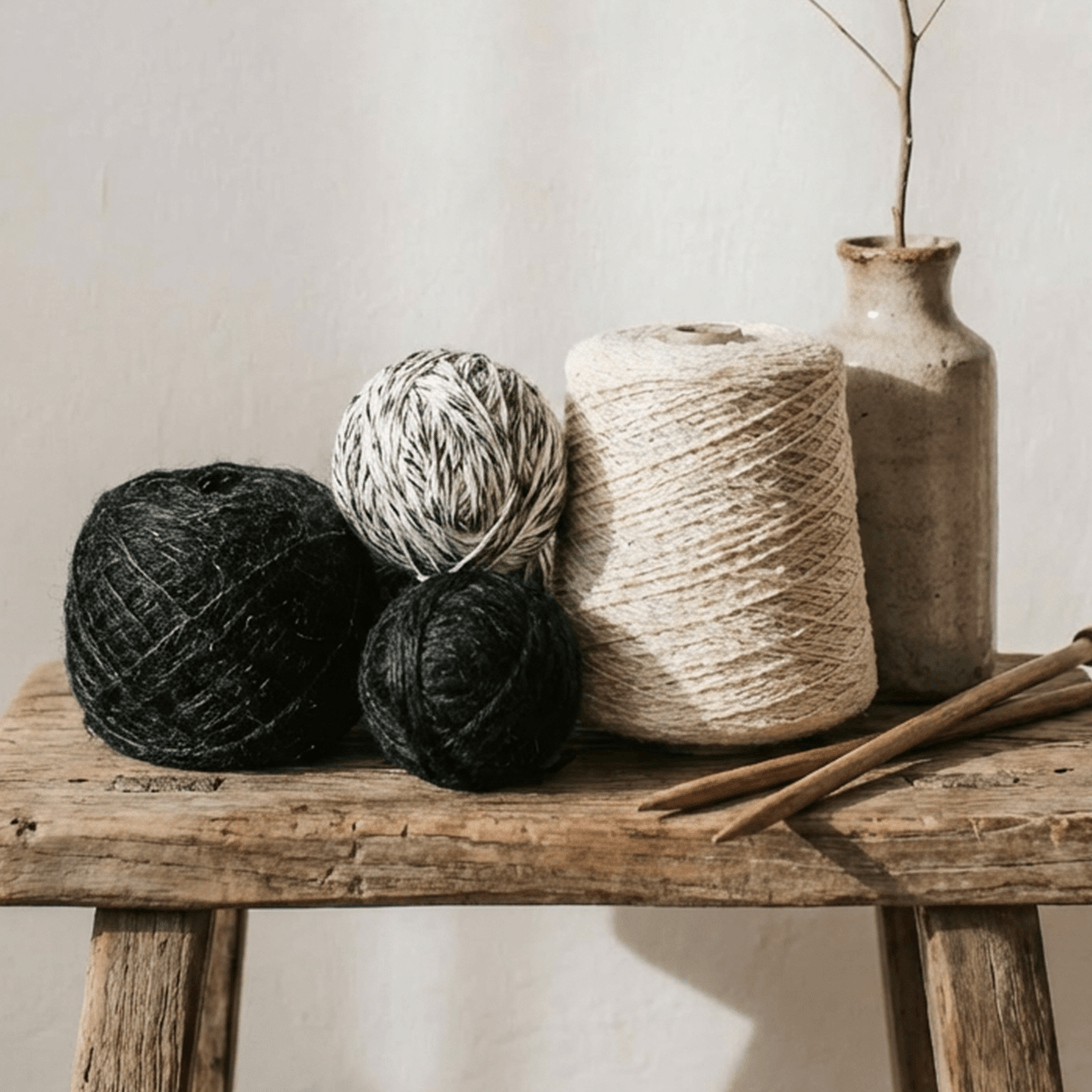
It also means much of the finest Japanese yarn is spun for machines, on cones, and reaches individual makers as surplus. On the cone it behaves like all industrial yarn — firm, sometimes oiled, transformed by washing. Our guide to blooming covers what to expect.
Designing for the season
Japanese yarn development takes the summer seriously in a way much of the Western tradition does not. A hot, humid climate rewards fibers and constructions that manage moisture, move air, and stay dry against the skin — and Japanese mills have spent decades refining exactly those.
This is why so many of the most interesting summer yarns are Japanese: washi, fine linens, paper-cotton and paper-rayon blends, silk-linen mixes, all engineered to float slightly off the body rather than cling. Where wool cultures optimise for warmth, Japanese spinning has, with equal seriousness, optimised for coolness.
| Japanese specialty | What it delivers |
|---|---|
| Washi / paper blends | Dry, light, breathable summer structure |
| Fine linen | Crisp handle, cooling, softens with wear |
| Silk-mohair lace | Luminous halo at featherweight |
| Functional blends | Engineered drape, moisture management |
Consistency as a quiet virtue
Across all of the above runs a single thread: an exacting attention to consistency that is itself part of the aesthetic. In a tradition that lets the material speak, any unevenness the maker did not intend becomes a flaw. So the fiber is selected carefully, the twist controlled tightly, the finishing judged precisely.
The result is yarn that does what it promises. Not showy, not attention-seeking, but dependable in a way that becomes its own kind of luxury — the luxury of a material you can trust to behave.
 A note on brands
A few Japanese names come up often, each illustrating one of the priorities above. It is worth placing them accurately rather than flattening them into one category.
ITO is drawn from small Japanese mills and known for fine silk and mohair — luminous, feather-light lace yarns that exemplify the restrained, material-first aesthetic. Its Sensai yarn, mohair with a high silk content, is a reference point for luxurious fine-gauge work.
Sawada (澤田), a knitwear-yarn company founded in 1969, is known for mohair spun from South African kid mohair, sourced through a traceable, ethically certified supply chain. Its signature DANDE yarn is built to bring out mohair's luster and character — invention and consistency applied to a single fiber done exceptionally well.
Hasegawa makes gima cotton, a "paper-touch" yarn in which cotton is given a dry, crisp, papery hand — airy yet structured, and a natural companion to true washi for summer knitting. It is the material-first, invention-for-climate instinct expressed in cotton rather than paper.
TAKIZEN (滝善) spins genuine washi blends. Its NERO yarn — Mino washi paper with cotton and rayon — is a textbook example of the functional Japanese summer blend: paper for dryness and structure, cotton for softness, rayon for drape. We examine it closely in our guide to what washi yarn is.
Beyond the named labels, much of the best Japanese yarn carries no consumer brand at all. It is spun for the knitwear and hosiery industries and reaches makers as mill-end surplus on cones — the same fine, consistent, quietly engineered yarn, simply without a retail name attached.
The brand matters less than the tradition behind it. A nameless Japanese cone spun to industrial tolerances often embodies the qualities in this article more completely than a famous skein does.
What to make of it
Japanese-spun yarn suits the maker who values what a material is over what it announces. Its refinement is real but quiet: it lives in the evenness of the spin, the intelligence of a blend, the way a summer fabric stays dry, the restraint of a palette that trusts the fiber.
Approached that way — slowly, attentively, with a swatch and a wash before judgement — it returns exactly the qualities it was engineered for. Which is, in the end, what refinement means: not decoration added on, but nothing unnecessary left in.
Frequently asked questions
What makes Japanese-spun yarn different?
A set of priorities more than any single fiber: a material-first aesthetic that favours restraint over decoration, a willingness to invent fibers and blends such as washi paper yarn, precision spinning at fine gauges, serious attention to summer and moisture-managing fibers, and an exacting consistency that is itself part of the appeal.
What is washi yarn, and why is it distinctly Japanese?
Washi is yarn spun from strips of traditional Japanese paper, usually blended with cotton, rayon, or silk. It produces dry, light, breathable, quietly structured fabric ideal for humid summers. No other textile culture developed paper yarn to the same depth, making it the clearest expression of the Japanese instinct to engineer a material for a climate.
Is Japanese yarn good for summer knitting?
Exceptionally. Japanese mills have refined summer fibers for decades — washi and paper blends, fine linens, silk-linen mixes — engineered to manage moisture and float slightly off the skin rather than cling. Where wool traditions optimise for warmth, Japanese spinning has equally optimised for coolness.
What is ITO yarn known for?
ITO is drawn from small Japanese mills and known for fine silk and mohair — luminous, feather-light lace yarns. Its Sensai yarn, mohair with a high silk content, is a well-known example of the refined, fine-gauge aesthetic.
Which Japanese mills exemplify these qualities?
ITO for fine silk-mohair lace; Sawada for South African kid mohair spun to bring out its luster; Hasegawa for gima "paper-touch" cotton; and TAKIZEN for genuine washi paper blends such as its NERO yarn. Each illustrates a different Japanese priority — refinement, single-fiber mastery, invention for climate, and functional summer blending.
Are all Japanese yarns quiet and understated?
No. There is a vivid countertradition of self-striping, deliberately uneven yarns that embrace nature's irregularity. Both aesthetics are authentically Japanese. The restrained, material-first approach is one strand of a broader tradition, not the whole of it.
Why is some Japanese yarn sold on cones without a brand?
Because much of the finest Japanese yarn is spun for the knitwear and hosiery industries rather than for retail. It reaches individual makers as mill-end surplus on cones — the same finely spun, consistent yarn, without a consumer label. It behaves like all cone yarn and blooms softer after washing.
Some yarns don't come back.
That Yarn drops new mill-end on the 1st and 15th.
Have a question about a specific cone? Write to us at hello@thatyarn.com — we answer every email.