That Yarn · Journal
When Does Yarn Bloom? Why Wool Softens After Washing
A cone that feels dry and hard is not a disappointing yarn. It is an unfinished one — and blooming is the moment it becomes itself. Here's when it happens, why, and how to do it right.

The first cone of industrial yarn is often a small shock. It looks beautiful. It feels wrong. Thin where it should be full, dry where it should be soft, faintly slick to the touch, and nothing like the garment you had in mind.
Nothing is wrong with it. What you are holding is a yarn that has not yet been finished, because the mill deliberately left that step undone. The transformation it undergoes on first washing has a name — blooming — and understanding it turns an unpromising cone into the most rewarding material on the shelf.
This guide covers what is actually on the yarn, what happens in the water, why the change is largely a single event rather than a gradual one, which fibers bloom and which do not, and how to do the washing properly.
What is on the yarn
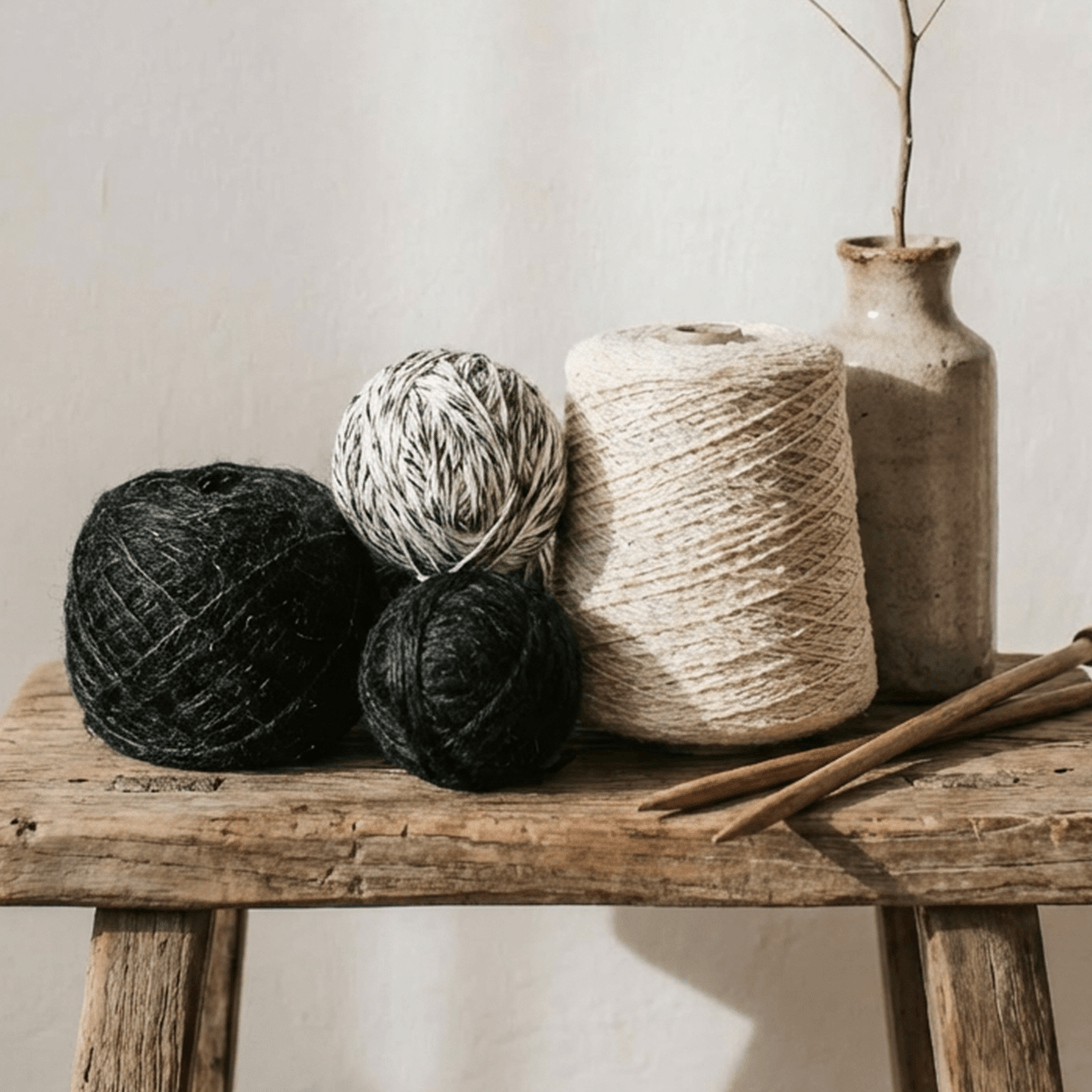
Begin with the thing almost no guide mentions. Industrial cone yarn arrives coated in spinning oil — also called coning oil or yarn oil — applied so the strand runs cleanly and quickly through machinery without friction, static, or breakage.
This is not contamination. It is a manufacturing requirement, and mills expect it to be washed out later.
Coning oil load = 0.5–6% of yarn weight · typically 3–5%
Sit with that figure. A one-kilogram cone may carry thirty to fifty grams of oil. You can sometimes feel it as a faint slickness, and sometimes smell it. What you cannot do is judge the yarn's true hand through it.
Mills leave the oil on because knitters and weavers — industrial ones — want control over the finished quality of the fabric. The oil comes out during wet finishing, at the fabric stage, where the manufacturer decides how soft, how dense, how fulled the cloth should be. Hand knitters inherit both the oil and the decision.
A cone is a yarn in its work clothes. It has not been dressed for the occasion yet, because the mill left that to you.
Why the yarn is also spun tight
The oil is the first reason a cone feels hard. Construction is the second.
Industrial spinning applies firm, consistent twist and winds the yarn under tension. Both serve production: tight twist resists breakage at high machine speeds, and even tension builds a cone of uniform density that unwinds predictably on a creel.
The consequence is a yarn holding stored energy. Fibers are compressed against one another, crimp is flattened, and the strand is thinner and denser than the same fiber would be at rest. Retail skeins, wound loosely and often already wet-finished once during dyeing, carry far less of this.
What happens in the water
Blooming is not one process. Four distinct things happen when a knitted swatch meets warm water, and conflating them is the source of most confusion.
| Process | Mechanism | Effect on fabric |
|---|---|---|
| Scouring | Detergent emulsifies and lifts the spinning oil | True hand revealed; yarn no longer slick |
| Relaxation | Twist energy releases; crimp reopens | Yarn plumps; fabric closes; gauge shifts |
| Halo | Short fiber ends migrate to the surface | Soft fuzz; light diffusion |
| Fulling | Wool scales interlock under warmth and agitation | Fabric densifies; stitches knit together |
The first two are what most people mean by blooming, and they are entirely benign. The third produces the soft glow characteristic of brushed and animal-fiber yarns. The fourth is the one to control, because it is irreversible.
Where the softness actually comes from
Popular explanations credit trapped air. Air is real — reopened crimp does trap it, and that is why bloomed fabric is warmer — but warmth and softness are two different outcomes with two different causes.
Softness comes from three things happening at once: the oil is gone, so fibers can move independently again; the twist has relaxed, so the strand is rounder and the fabric less rigid; and the fiber surface has been rehydrated and rearranged by water. Air fills the space this creates. It does not create the space.
This distinction matters practically. A yarn that has been washed but not properly scoured will feel a little better and remain slightly dull. One scour with real detergent does more than three rinses in plain water.
The honest correction: blooming is mostly one event
Yarn is often described as growing softer with every wash, indefinitely. This is a lovely idea and it is not what happens.
The overwhelming majority of the transformation occurs at the first wet finishing. The oil comes off once. The twist relaxes once. Crimp reopens once. By the time the swatch is dry, the yarn has substantially become what it will be.
Afterwards, the garment does keep changing — but through wear, not washing. Friction lifts more fiber ends, which softens the surface and simultaneously produces pilling. Repeated washing gradually fulls wool a little further. These are real, and they are not the same as blooming. Some of them are wear, and wear has a direction.
Blooming is a threshold, not a slope. Cross it once, deliberately, and the yarn shows you what it is. Everything after that is the life of the garment.
The practical consequence is important. If you knit an entire sweater without swatching and washing first, you do not discover the yarn's true gauge, hand, or dimensions until the sweater is finished. By then the discovery is expensive.
Which yarns bloom, and how much
Blooming potential depends on fiber structure, spinning system, and how much finishing the mill already did.
| Fiber or construction | Bloom | What to expect |
|---|---|---|
| Woollen-spun wool | Dramatic | Plumps, fuzzes, closes; large gauge shift |
| Worsted-spun wool | Moderate | Softens, rounds; stitch definition sharpens |
| Yak | Marked | Quiet halo emerges; warmth increases |
| Cashmere | Marked | Opens and softens considerably; gauge loosens |
| Alpaca | Moderate | Halo develops; fabric grows and drapes |
| Brushed mohair | Dramatic | Halo opens fully; measure only after washing |
| Cotton | Slight | Softens; little loft, no halo |
| Linen | Gradual | Softens over many washes and much wear |
| Washi and paper | Minimal | Stays dry and crisp by design |
| Superwash wool | Reduced | Scales altered; will not full, blooms less |
Linen is the honest exception to everything above. It does soften with every wash, genuinely and over years — but by a different mechanism entirely, as the fiber bundles gradually separate. Linen is not blooming. Linen is wearing in.
Superwash wool deserves its own note. The treatment that stops it felting also stops it fulling, and dulls the bloom. This is a trade, not a defect: superwash gives you a machine-washable garment and takes back some of the transformation.
How to bloom a yarn properly
Industrial finishing rooms scour knitted goods twice, and it is worth knowing why. The first pass removes the oil. The second develops the handle. Hand knitters can follow the same logic at kitchen scale.
Before you begin
Swatch first, always, and swatch generously — at least six inches square, in the stitch pattern and strand count you intend to use. The swatch is the only place where the yarn will tell you the truth before it costs you a sweater.
The wash
- Fill a basin with water at roughly 104°F (40°C) — comfortably warm to the hand, never hot. Sudden temperature change is what felts wool.
- Add a detergent capable of lifting oil. An enzyme-free, non-antibacterial dish soap works well. A wool wash alone may not fully scour a heavily oiled cone.
- Submerge the swatch. Let it sit for several minutes so the emulsifier can work. Move it gently; do not agitate, wring, or rub.
- Drain, then rinse in water of the same temperature. Repeat until the water runs clear.
- If the yarn was heavily oiled, scour a second time with less detergent. This is the pass that develops the soft handle.
- Press out water by squeezing downward, or roll in a towel. Never wring.
- Lay flat, shape gently, and dry away from direct heat and sunlight.
- When completely dry, measure again. Compare to your pre-wash measurement.
The difference between those two measurements is the single most valuable number the yarn will give you. It tells you whether the fabric closed or opened, grew or shrank, and by how much.
Wash the swatch, or wash the cone?
Both are legitimate, and they produce different results.
Washing the finished piece — knit first, scour after — is what industrial finishing does, and it yields a tighter, harder-wearing fabric. The stitches set against one another as the yarn blooms in place.
Washing the yarn first, by winding it into loose hanks and scouring before knitting, gives a softer, more open fabric and lets you knit with clean, unoiled yarn. Hand spinners and some machine knitters prefer this. The trade is that you must re-skein and re-wind, and the yarn will have lost some of the smooth glide that made it pleasant on the needles.
For most hand knitters working from a cone: swatch, wash the swatch, knit, then wash the finished piece. It is the path with the fewest surprises.
When blooming goes wrong
| What happened | Likely cause | Response |
|---|---|---|
| Fabric shrank and hardened | Too hot, or agitated — you fulled it | Irreversible. Lower temperature next time |
| Still feels dry and dull | Oil not fully scoured | Wash again with proper detergent |
| Fabric grew and sagged | Low-memory fiber; hung while wet | Dry flat, not hanging |
| Stitch definition blurred | Woollen-spun or brushed fiber blooming as intended | Not a fault; choose worsted-spun for crisp stitches |
| Colour bled | Excess unbound dye, normal on first wash | Rinse until clear; wash dark shades separately |
Only the first of these is unrecoverable. Felting is a one-way door: once wool scales have interlocked, they do not release. Everything else is correctable, and most of it is not a fault at all.
Why this is worth doing
Cone yarn asks for a step that retail yarn has already taken on your behalf. In exchange, it gives you the yarn as the mill made it — undiminished by a finishing decision someone else made to suit an average customer.
You choose how far to take it. Scour lightly for a crisp, defined fabric. Scour twice and warm for a softer, fuller one. Full deliberately for something dense and weatherproof. The same cone yields all three.
The yarn that felt disappointing on the shelf was never disappointing. It was waiting.
Frequently asked questions
When does yarn bloom?
Yarn blooms the first time it is washed and dried after knitting or weaving — this is when the transformation happens. Washing rinses away the spinning oil and lets fibers that were spun tight relax, so the yarn plumps, softens, and fills out. It happens mostly at that first wet finish, not gradually over many washes. This is why you should always wash a swatch before judging a cone yarn: the yarn on the cone hasn't bloomed yet.
What is yarn blooming?
The transformation a yarn undergoes on first wet finishing: spinning oil is scoured away, twist energy releases, crimp reopens, and short fiber ends rise to the surface. The yarn plumps, softens, and the fabric closes. It is most pronounced in industrial cone yarn, which is sold before this step has been done.
Why does cone yarn feel hard and dry?
Because it carries spinning oil — typically three to five percent of its weight — applied so it runs through machinery cleanly, and because it is spun with firm twist under tension. Both are removed or released by washing. Neither is a defect.
Does yarn really get softer with every wash?
Not indefinitely. Nearly all of the blooming happens at the first proper wash. After that a garment continues to change through wear, which softens the surface but also causes pilling. Linen is the genuine exception: it keeps softening for years, by a different mechanism.
Should I wash cone yarn before or after knitting?
Either works. Washing the finished piece gives a tighter, harder-wearing fabric and is what industrial finishing does. Washing the yarn first, wound into loose hanks, gives a softer, more open fabric. Whichever you choose, always wash a swatch first.
What temperature should I use?
Around 104°F (40°C) — comfortably warm to the hand, never hot. Use the same temperature for rinsing. Sudden temperature changes and agitation are what cause wool to felt, and felting cannot be undone.
What detergent removes spinning oil?
One capable of emulsifying oil. An enzyme-free, non-antibacterial dish soap works well. Many gentle wool washes will not fully scour a heavily oiled cone. Professional finishing scours twice: the first pass removes the oil, the second develops the soft handle.
Which yarns bloom the most?
Woollen-spun wool and brushed mohair change most dramatically. Yak, cashmere, and alpaca bloom markedly, developing halo and warmth. Cotton softens slightly. Washi and paper yarns stay crisp by design. Superwash wool blooms less, because the treatment that prevents felting also limits the change.
My swatch shrank and went stiff. Can I fix it?
No. That is felting — wool scales interlocked under heat and agitation, and the process is irreversible. Use cooler water, keep rinse water the same temperature as the wash, and handle the fabric gently rather than rubbing it.
Some yarns don't come back.
That Yarn drops new mill-end on the 1st and 15th.
Have a question about a specific cone? Write to us at hello@thatyarn.com — we answer every email.