That Yarn · Journal
Understanding Industrial Yarn: Why It Arrives Unfinished
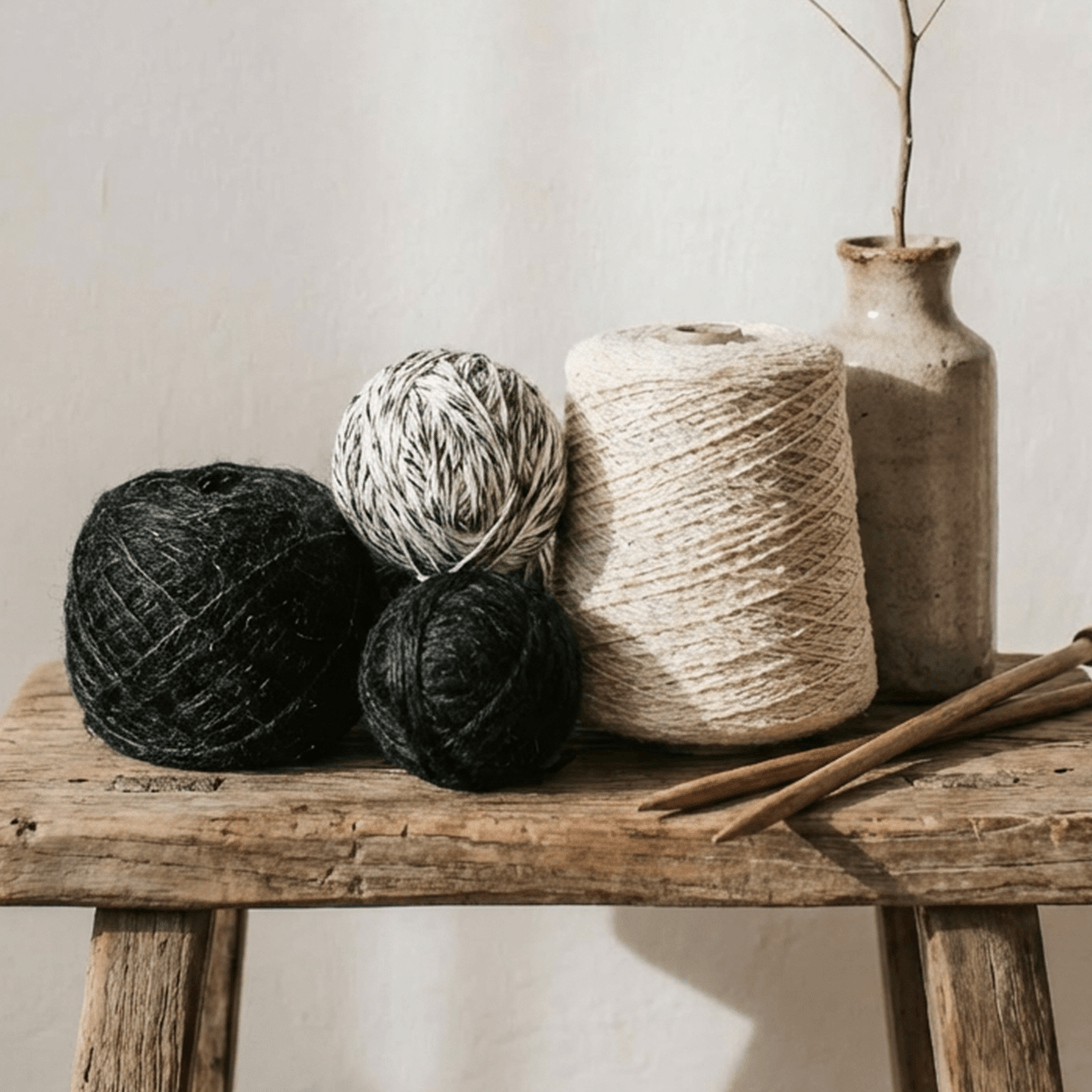
A cone is not a skein that skipped a step. It is a different product, made for a different buyer, sold at a different point in its life — and the missing step was withheld on purpose.

Retail yarn is sold finished. It has been dyed, washed, dried, and wound, and it feels on the shelf approximately the way it will feel in a garment. Nothing is being held back.
Industrial cone yarn is sold unfinished, and the difference is not carelessness. Somewhere in a mill, a technician decided to stop short — to leave the oil on, to wind under tension, to ship a yarn that has not yet become what it will be. Understanding why that decision gets made is the difference between a maker who is disappointed by a cone and one who knows exactly what they are holding.
This is the supply chain, not the chemistry. What happens when you finally wash the yarn is covered in our guide to blooming. What follows is why nobody washed it first.
Two products, two customers
The cone and the skein are not two grades of the same object. They are made for people who want opposite things.
| Retail skein | Industrial cone | |
|---|---|---|
| Buyer | A person, once | A factory, by the tonne |
| Next step | Knitting, by hand | Machine knitting, at speed |
| Finishing | Already done | Deferred to the fabric stage |
| Surface | Clean, bloomed | Oiled, compact |
| Winding | Loose | Under tension |
| Optimised for | How it feels now | How it runs through a machine |
Read the last row. Everything else follows from it.
A knitting machine runs yarn at high speed through metal guides and past thousands of needles. Friction breaks it. Static tangles it. An uneven package feeds unevenly and drops stitches. So the mill applies a lubricant, winds a cone of uniform density, and clears the yarn of weak points. Every one of these choices serves the machine, and every one of them makes the yarn feel worse in the hand.
A cone is a yarn optimised for a machine that has not met it yet.
What the mill actually does
Three processes stand between spinning and the cone that arrives at your door, and they are frequently conflated.
Coning, or winding
Yarn is transferred from spinning bobbins onto the conical package the industry runs from. It is wound at speed — up to a thousand yards a minute — and under controlled tension, producing a cone of even density that will unwind predictably on a creel. Too hard and it will not release. Too soft and it will collapse.
Clearing
During the same pass, the yarn runs through a clearer that detects and cuts out faults: thick places, thin places, neps, weak splices. The ends are rejoined. This is what makes industrial yarn so remarkably consistent, and it is a step retail yarn often skips.
Oiling
A coning oil is applied — by kiss roll, trough, or metering device — as the yarn winds.
Coning oil = 0.5–6% of yarn weight · typically 3–5%
A one-kilogram cone may therefore carry thirty to fifty grams of oil. The formulation is engineered: it must lubricate fiber against metal and fiber against fiber, suppress static, resist being flung off at high speed, and — crucially — scour out cleanly when the time comes. That last property, scourability, is a design requirement. The oil is meant to leave.
None of this is a shortcut. Coning is an additional, expensive operation performed because the buyer is a factory.
Why finishing is deferred
Here is the part that explains everything else.
When a knitwear factory buys cone yarn, it does not want soft yarn. It wants yarn that runs cleanly through a Shima Seiki flat-knitting machine, and it wants to make the softness decision itself, later, on the finished garment.
That decision happens in the finishing room, after the panels are knitted and linked. There the fabric is scoured, and how it is scoured determines what the garment becomes: how soft, how dense, how much the wool fulls, how much halo rises. A crisp, defined jersey and a soft, fulled one can be knitted from the same cone.
If the mill pre-washed the yarn, it would be making that decision on the factory's behalf — and getting it wrong for most of them. So it leaves the yarn oiled, tight, and neutral, and lets each customer finish it their own way.
The cone is unfinished because finishing is a decision, and the mill declined to make it for you.
When that cone becomes surplus and reaches a hand knitter, the deferred decision comes with it. You inherit the oil, the tension, and the authority.
Woollen, worsted, and why some cones feel rougher
Not all industrial yarn arrives equally compact, and the reason is the spinning system rather than the coning.
Worsted-spun yarn is combed so fibers lie parallel. It is smooth, dense, and strong, and it shows stitches crisply. Woollen-spun yarn is carded, fibers lying every which way, trapping air. It is light and lofty — but on the cone, wound tight and oiled, that loft is compressed flat. It reads as rough precisely because its character is being suppressed.
This is why woollen-spun cones transform most dramatically after washing, and worsted-spun cones least. A woollen-spun merino has loft to recover. A worsted-spun merino was never lofty to begin with.
A worked example
UPW, a Hong Kong spinning company established in 1984 and known for woollen, semi-worsted, and fancy spinning, sells stock-supported yarns to knitwear factories worldwide. Their extrafine merino cones are woollen-spun — which is exactly why a cone of it feels compact and slightly rough on arrival, and why it plumps so noticeably once washed.
| Label | Finished count | Meters / 100g |
|---|---|---|
| 2/17.5Nm | 8.75Nm | 875 |
| 2/26Nm | 13Nm | 1,300 |
| 1/4Nm | 4Nm | 400 |
If those counts are unfamiliar, our guide to yarn weight and Nm covers how to read them and how many strands to hold.

What a mill end actually is
Cone yarn reaches makers because factories over-order. A knitwear producer buys enough for a season's run plus a margin for error, and when the run ends the remainder sits in a warehouse. It may be a few kilograms. It may be a tonne.
These surplus lots are mill ends: authentic mill-spun yarn, unused, in the exact state the factory received it. Oiled. Tight. Sometimes fully labelled, often not — because a factory buying by the tonne does not need a consumer label, and the paperwork stays with the purchase order rather than the cone.
Which produces a consequence worth stating plainly. Where a spec is missing, it is missing. A cone honestly described as washi blend, percentages undisclosed is more trustworthy than one carrying a confident number nobody can verify. The absence of data is information; inventing a figure to fill the gap is not.
It also means there is rarely a second lot. Dye batches differ, the run is over, the mill has moved on. This is a structural fact about surplus, not a sales tactic.
What to do with a cone
Three practical adjustments follow from everything above.
Rewind, and know why
Winding a cone into a cake or ball before knitting releases the tension the mill wound in and lets air back between the plies. Some knitters skip this and work straight from the cone, which is fine for a yarn wound loosely. For a firmly wound cone, rewinding makes a difference you can feel.
This is not the same operation as the mill's coning. The mill winds on tension for machine feeding; you are winding it off again for hands.
Knit slightly looser
Fabric closes as the yarn blooms. Knit to the density you want after washing, not before — which usually means going up a needle size from what the unwashed swatch suggests. Brushed and woollen-spun yarns need the most room.
Swatch, wash, measure
An unwashed swatch will mislead you about gauge, hand, and dimensions simultaneously. Wash it exactly as you plan to wash the garment, dry it flat, and measure again. The difference between the two measurements is the most useful number the yarn will give you.
The two temperatures
Cone yarn involves two different washing jobs, and they call for different water. Conflating them is how good cones get ruined.
| Job | Water | Why |
|---|---|---|
| Scouring off spinning oil | ≈ 104°F (40°C) | The oil's emulsifier needs warmth to lift |
| Routine care of a wool garment | ≤ 86°F (30°C) | Cooler water is safer against felting |
Scour once, warm and deliberate, to remove the oil and bloom the fabric. Then care for the finished garment cool and gently for the rest of its life. Whatever the temperature, keep the rinse water the same as the wash water — sudden change and agitation are what felt wool, and felting cannot be undone.
Why this is worth the extra step
An unfinished cone asks you to do something a skein has already done for you. In return, it hands over a decision that was made on your behalf everywhere else — and a yarn that was cleared, measured, and spun to a factory's tolerances rather than a shelf's.
The roughness on arrival is not the yarn's character. It is the yarn's packaging, chosen by a mill for a machine, and it comes off in warm water. What is underneath was never in doubt.
Frequently asked questions
Why does industrial cone yarn feel rough or compact?
Because it carries coning oil — typically three to five percent of its weight — and is wound under tension so it feeds evenly through knitting machines. Both serve the factory, and both make the yarn feel harder in the hand than it truly is.
Why don't mills wash the yarn before selling it?
Because their customers are knitwear factories, which scour the finished garment themselves. How a fabric is scoured determines how soft, dense, and fulled it becomes. Pre-washing the yarn would make that decision for the factory. The mill leaves it neutral instead.
What is coning oil?
A lubricant applied as yarn is wound onto cones, so it runs cleanly at high speed without friction, static, or breakage. It is engineered to scour out cleanly with detergent. It is a manufacturing requirement, not a contaminant.
What is the difference between a cone and a skein?
A skein is finished and sold to a person for hand knitting. A cone is unfinished and sold to a factory for machine knitting: oiled, wound under tension, and cleared of faults. Retail skeins usually pass through wet processing during dyeing, which is why they feel soft on the shelf.
Should I rewind cone yarn before knitting?
For a firmly wound cone, yes. Winding it into a cake releases the tension the mill wound in and lets air back between the plies. Loosely wound cones can be knitted from directly.
What temperature should I wash cone yarn at?
Around 104°F (40°C) for the initial scour that removes spinning oil, since the emulsifier needs warmth. Afterwards, care for the finished garment at 86°F (30°C) or below. Keep rinse water the same temperature as the wash water — sudden changes cause felting.
What is a mill end?
Surplus yarn from a knitwear factory's over-order, unused and in the state the factory received it. Mill ends are authentic mill-spun yarn, frequently without full consumer labelling, because a factory buying by the tonne keeps the specification on the purchase order rather than the cone.
Why do some cones bloom more than others?
Because of the spinning system. Woollen-spun yarn is carded and lofty, but wound tight and oiled that loft is compressed flat — so it recovers dramatically. Worsted-spun yarn is combed smooth and dense, and was never lofty, so it changes less.
Some yarns don't come back.
That Yarn drops new mill-end on the 1st and 15th.
Have a question about a specific cone? Write to us at hello@thatyarn.com — we answer every email.