That Yarn · Journal
WPI, Nm, and Tex: One Yarn, Three Measurements
Three systems, one strand. Why the mill, the spinner, and the hand knitter each describe the same yarn differently — and how to move between them.
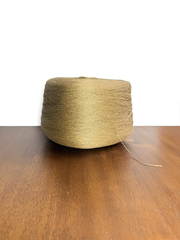
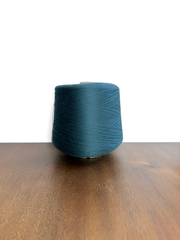
A cone arrives labelled 2/28Nm. A weaving pattern asks for 200 Tex. A spinning book says to aim for 14 wraps per inch. These are three descriptions of thickness, written in three languages, and it is entirely possible that they describe the same yarn.
They persist side by side because each was built for a different purpose. Nm serves the mill, where yarn is bought and sold by weight. Tex serves engineering, where a single consistent unit is worth more than tradition. WPI serves the hand — a measurement you can take with a ruler, no label required.
Understanding all three is not academic. It is what lets you read an industrial cone, a weaving draft, and a spinning guide without translating badly between them.
The fundamental divide: direct and indirect
Before the individual systems, one distinction organises everything.
Some systems measure length per unit weight. Ask: how many meters in one gram? A finer yarn packs more meters into that gram, so the number rises as the yarn gets thinner. These are called indirect systems, because the number moves opposite to the thickness.
Other systems measure weight per unit length. Ask: how many grams in one thousand meters? A finer yarn weighs less over that fixed length, so the number falls as the yarn gets thinner. These are direct systems, because the number moves with the thickness.
| System | Type | Measures | Higher number means |
|---|---|---|---|
| Nm | Indirect | Meters per gram | Finer |
| WPI | Indirect | Wraps per inch | Finer |
| Tex | Direct | Grams per 1,000 m | Thicker |
| Denier | Direct | Grams per 9,000 m | Thicker |
Nearly every error in reading yarn counts comes from forgetting which kind of system you are in. A 2/28Nm cone is fine. A 280 Tex yarn is thick. Both numbers are large.
Ask one question before reading any yarn count: is the weight fixed, or is the length fixed? The answer tells you which direction the number runs.
Nm: the mill's language
Nm — Numéro métrique, number metric — states how many meters of a single strand weigh one gram. A 1/28Nm yarn holds 28 meters per gram, and therefore 2,800 meters per 100g cone.
Length in meters = Nm × weight in grams
Most cone yarn is plied, and the label reflects this as ply over count. A 2/28Nm yarn is two 28-count strands twisted together. Each strand alone is 28 meters per gram; combined, the finished yarn measures 14 meters per gram.
Finished Nm = count ÷ number of plies
So 2/28Nm has a finished count of 14Nm, or 1,400 meters per 100g. That finished figure — not the single-strand count — is what your hands feel and what your pattern needs. Our full guide to yarn weight and Nm works through this in detail, including how to ply single strands toward a heavier weight.
Why mills use it
A mill buys fiber by weight and sells yarn by weight. Nm answers the only question that matters at that scale: for a given mass of fiber, how much yarn came out of it? Higher Nm means a finer spin, more length per kilogram, and — usually — a finer, more valuable fiber.
Tex: the engineer's language
Tex states how many grams 1,000 meters of yarn weighs. A 200 Tex yarn weighs 200 grams per kilometer. Double the thickness and you double the Tex.
Tex = grams per 1,000 meters
Its virtue is arithmetic. Because Tex is a direct system with a fixed length, plying is simple addition. Two strands of 50 Tex twisted together make a 100 Tex yarn. Three make 150. There is no division, no reciprocal, no confusion about whether the number represents the single or the finished thread.
This is why Tex dominates technical textile work, industrial specification, and sewing thread. It is also why it appears on spec sheets more often than on consumer labels — it is a working number, not a marketing one.
Decitex and dtex
You will meet dtex (decitex) on filament yarns, particularly synthetics and reeled silk. It states grams per 10,000 meters, so it is simply Tex multiplied by ten. A 100 Tex yarn is 1,000 dtex. The finer resolution suits filaments, which are extremely light for their length.
Denier: the filament survivor
Denier states grams per 9,000 meters. The odd number is historical — it derives from the weight of a fixed length of silk, and it has survived because the silk and synthetic filament trades never fully switched.
Denier = grams per 9,000 meters = Tex × 9
You will encounter it on silk, nylon, and hosiery. You will rarely encounter it on a cone of wool or cashmere. If a spec sheet gives you denier and you think in Tex, divide by nine.
WPI: the hand's language
Wraps per inch requires no label at all. Wrap the yarn around a ruler or a dowel, snug but not stretched, with each wrap touching its neighbour and none overlapping. Count the wraps that fill one inch. More wraps means a finer yarn.
Hand spinners rely on it because their yarn arrives without a label. Knitters use it to identify an unmarked ball. Weavers use it as the first step toward calculating sett.
Its honest limitations
WPI is a measure of diameter under light compression, not of mass. Two consequences follow, and both matter.
First, a lofty woollen-spun yarn and a dense worsted-spun yarn can give the same WPI while weighing very differently. The lofty yarn traps air; the dense one does not. Their WPI matches, their Nm does not, and a garment knit from each will differ in weight and warmth.
Second, WPI depends on the hand doing the wrapping. Tension varies. Two people measuring the same yarn routinely differ by one or two wraps. Squash a soft single as you wrap it, and you will read it as finer than it is.
WPI tells you what a yarn looks like. Nm and Tex tell you what it is. For unlabelled yarn, WPI is invaluable. For a labelled cone, it is a rough check, not a correction.
| WPI | Approximate US weight | Approximate meters / 100g |
|---|---|---|
| 30–40 | Lace | 500+ |
| 19–22 | Fingering | 300–500 |
| 15–18 | Sport | 250–300 |
| 12–14 | DK | 200–250 |
| 9–11 | Worsted | 150–200 |
| 7–8 | Bulky | 100–150 |
Read this table as orientation. The meters-per-100g column assumes a moderately dense yarn; a lofty woollen spin will land at the same WPI with fewer meters per gram, and a compact worsted spin with more.
Converting between systems
Nm and Tex convert exactly, because both are defined by mass and length. Neither converts exactly to WPI, because WPI does not measure mass at all.
Nm to Tex, and back
One gram of a 1Nm yarn is one meter long. A kilometer of it therefore weighs 1,000 grams. Divide 1,000 by the Nm and you have Tex.
Tex = 1,000 ÷ Nm · Nm = 1,000 ÷ Tex
Use the finished Nm, not the single-strand count. A 2/28Nm cone has a finished count of 14Nm, so:
1,000 ÷ 14 = 71.4 Tex
Working backwards from a weaving draft that specifies 71 Tex, you would divide 1,000 by 71 and arrive at roughly 14Nm — the same cone.
| Label | Finished Nm | Tex | Meters / 100g |
|---|---|---|---|
| 1/60Nm | 60 | 16.7 | 6,000 |
| 2/48Nm | 24 | 41.7 | 2,400 |
| 2/30Nm | 15 | 66.7 | 1,500 |
| 2/28Nm | 14 | 71.4 | 1,400 |
| 2/15Nm | 7.5 | 133.3 | 750 |
| 2/8Nm | 4 | 250 | 400 |
Denier to Tex
Tex = denier ÷ 9 · denier = Tex × 9
And therefore, chaining through Tex: Nm = 9,000 ÷ denier.
Anything to WPI
There is no formula, and any table that offers one is offering an approximation. WPI depends on fiber loft, ply structure, twist, and the hand of the person wrapping. The table above will place a yarn within a category. It will not place it precisely.
If a pattern gives WPI and you hold a labelled cone, the reliable move is to bypass WPI entirely: convert the cone's Nm to meters per 100g, match that against the weight category the pattern implies, and then swatch.
Which system to use, and when
| Situation | Use | Why |
|---|---|---|
| Reading a cone label | Nm | It is what the mill printed |
| Buying by yardage | Nm | Converts directly to meters per gram |
| Plying calculations | Tex | Plies add; no reciprocals |
| Weaving sett | WPI or Tex | Sett derives from diameter and density |
| Identifying stash yarn | WPI | No label required |
| Sewing thread, filament | Tex or denier | Trade convention |
| Substituting in a pattern | Meters per 100g | The only figure patterns truly rely on |
The last line is worth dwelling on. Whichever system a label uses, the number that decides whether you have enough yarn — and whether the yarn suits the pattern — is meters per 100g. Every system above can be driven toward that figure. Our method for substituting yarn in any pattern begins there for exactly this reason.
A worked example
A weaving draft calls for a warp of 70 Tex wool. Your shelf holds a cone labelled 2/28Nm. Are they the same?
- Find the finished count: 28 ÷ 2 = 14Nm
- Convert to Tex: 1,000 ÷ 14 = 71.4 Tex
- Compare: 71.4 against 70 — a difference of two percent
They are the same yarn for practical purposes. A two percent variance sits inside normal spinning tolerance, and well inside the variance introduced by fiber, twist, and finishing.
Now sanity-check by hand. Wrap the cone: it should read around 20 to 22 WPI, placing it in fingering territory. And 14Nm gives 1,400 meters per 100g, which the table confirms as fingering. Three systems, one yarn, no contradiction.
When the three do contradict — when the WPI reads far finer than the Nm suggests — you have learned something real. Usually it means the yarn is compressible: a lofty woollen spin, or a soft single that squashes under the ruler. That is information about the fabric it will make, not an error to correct.
Frequently asked questions
Is a higher Nm thicker or thinner?
Thinner. Nm counts meters per gram, so a finer strand packs more meters into each gram and produces a higher number. Tex runs the opposite way — a higher Tex means a thicker yarn.
How do I convert Nm to Tex?
Divide 1,000 by the finished Nm count. A 2/28Nm cone has a finished count of 14Nm, so 1,000 ÷ 14 = 71.4 Tex. To go the other way, divide 1,000 by the Tex.
Do I use the single-strand count or the finished count?
The finished count, for every calculation that concerns the yarn in your hands. Divide the count by the number of plies: 2/28Nm becomes 14Nm. The single-strand figure describes how the yarn was spun, not what it now is.
Can I convert WPI to Nm?
Not precisely. WPI measures diameter under light compression, while Nm measures mass per length. A lofty yarn and a dense yarn can share a WPI and differ substantially in Nm. Use WPI to place an unlabelled yarn in a category, then swatch.
Why do two people measure different WPI on the same yarn?
Because wrapping tension varies. Yarn compresses, and a firmer hand reads finer. Wrap snugly without stretching, keep the wraps touching but not overlapping, and expect a variance of one or two wraps between measurers.
What is the difference between Tex and denier?
Both are direct systems measuring grams per fixed length. Tex uses 1,000 meters; denier uses 9,000. Denier is therefore Tex multiplied by nine, and survives mainly in silk and synthetic filament.
Which measurement should I use when buying cone yarn?
Convert whatever the label gives you into meters per 100g. That figure tells you how much yarn you have and which weight category it belongs to, which is what any pattern actually needs.
Some yarns don't come back.
That Yarn drops new mill-end on the 1st and 15th.
Have a question about a specific cone? Write to us at hello@thatyarn.com — we answer every email.