That Yarn · Journal
What Is Cashwool? Inside Italy's Extrafine Merino
It is called the cashmere of merino, and it contains no cashmere at all. What the name actually promises, why the softness is engineered rather than inherited, and how to knit a yarn this fine.
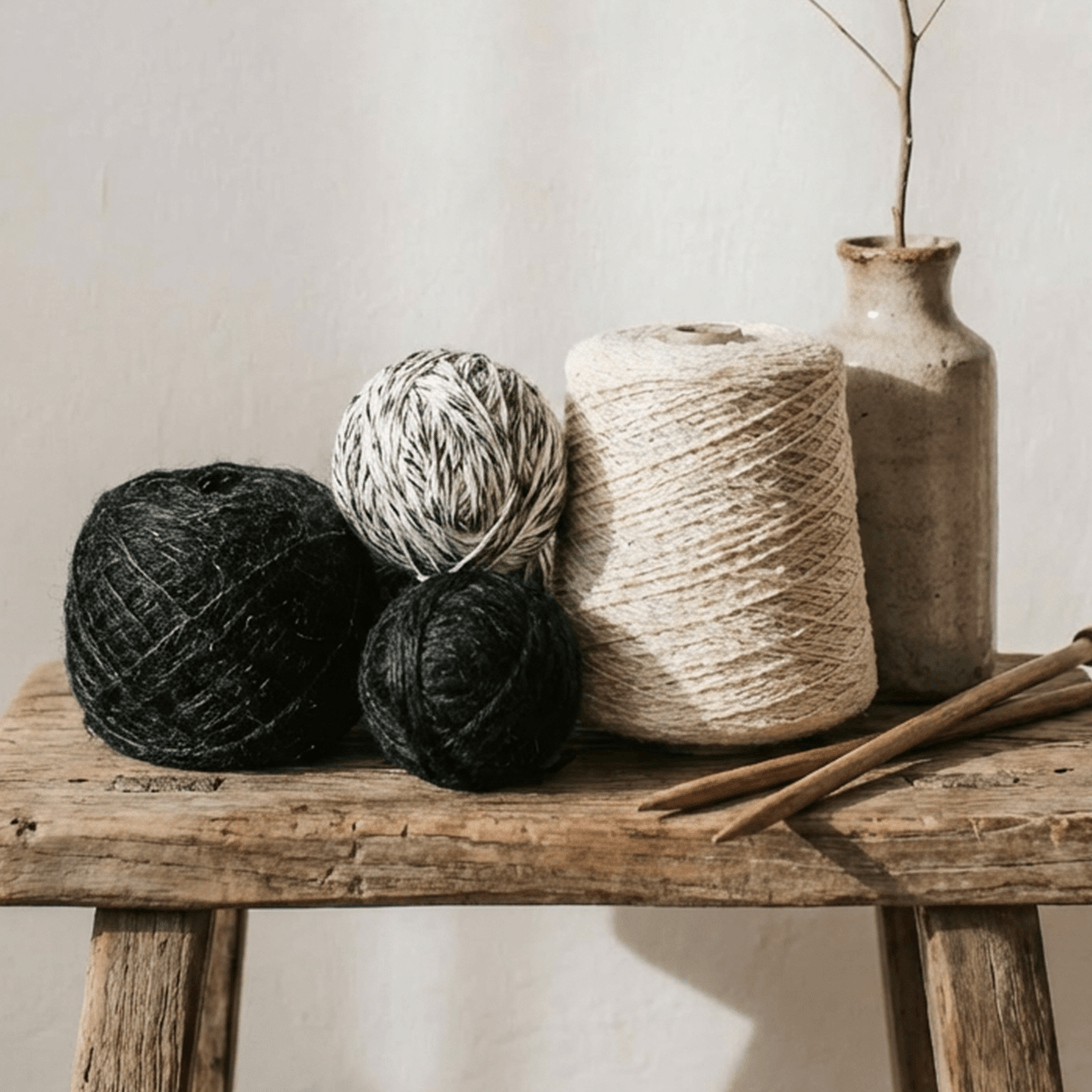
Hold a cone of Cashwool and the first impression is a category error. It is smooth in a way wool is not supposed to be — lustrous without shine, dense without weight, and soft enough that hands accustomed to cashmere reach for the wrong word.
The wrong word is the one in the name. Cashwool contains no cashmere. It is one hundred percent extrafine merino, and the cash in Cashwool describes an ambition, not an ingredient.
What follows is what the name actually means: who makes it, what the 19.5 micron figure does and does not tell you, why its softness is a manufacturing outcome rather than a property of the fleece, and — the question most guides skip entirely — how a yarn this fine is meant to be knitted.
Who makes it
Cashwool® is a registered yarn from Zegna Baruffa Lane Borgosesia, a spinning company founded in 1850 near Biella, in the Piedmontese foothills that have anchored Italian wool spinning for well over a century.
The yarn was developed in 1978, the product of a long search for a wool that could hold the smoothness and hand of cashmere without ceasing to be wool. It has since become the mill's flagship, and its reference point: a benchmark against which other fine merino yarns are positioned.
A note on the date. Cashwool is often described as a product of "the 1970s," which is true but imprecise. The manufacturer dates it to 1978, and that is the year worth citing.
The fiber
Cashwool is spun from extrafine merino measuring 19.5 microns or finer. Most of this fleece comes from Australia, where merino breeding has been directed toward fineness for generations.
Nineteen and a half microns places the fiber at the boundary of what is comfortable directly against skin — in the older Bradford vocabulary, roughly 70s. This is fine wool by any standard. But fineness is where most explanations of Cashwool stop, and it is precisely where the interesting part begins.
Why fine is not the same as soft
A micron figure is an average. It describes the centre of a distribution, and says nothing about the distribution's tail.
Prickle — the sensation of a garment itching against skin — is not caused by average fineness. It is caused by the small proportion of fibers coarser than roughly 30 microns, whose stiff ends refuse to buckle and instead press into the skin. Two wools with identical mean diameters can feel entirely different if one has a wider spread than the other. We work through this in detail in our guide to micron, S-count, and comfort factor.
Which means that a mill wanting reliable softness cannot simply buy fine wool. It has to buy fine wool and control the variation. This is expensive, tedious, and invisible on a label — and it is the actual explanation for how Cashwool feels.
What the control looks like
Zegna Baruffa publishes its testing regime, and the numbers are worth reading not as marketing but as a description of what narrow-distribution spinning costs.
| Stage | Checks per batch | What is being controlled |
|---|---|---|
| Sliver | ≈ 10,000 | Fineness, cleanliness, homogeneity |
| Spinning | ≈ 12,000 | Strength, elasticity, twist, count |
| Pre-dispatch | ≈ 5,000 | Moisture, slippage, performance |
Read the first row again. Homogeneity is the word that matters. Ten thousand checks on the sliver is a distribution being narrowed — coarse fibers found and removed before they can reach a garment and press against a shoulder.
Fiber selection is independently verified for fineness, crimp, and staple length. That third parameter is the one that quietly governs how the finished garment ages.
The softness of Cashwool is not inherited from the sheep. It is manufactured — by selection, by combing, by refusing the fibers at the coarse end of the distribution.
Pilling, and why staple length explains it
Cashwool is often described as resisting pilling better than many cashmere blends. The claim is broadly fair, but it is usually offered as a brand attribute rather than a mechanism — and the mechanism is what makes it useful.
Pills form when short fiber ends work loose from the yarn surface, tangle, and ball up. Two things reduce this: longer staple, because long fibers are anchored more firmly in the twist and have fewer ends per unit of yarn; and worsted spinning, which combs fibers parallel and lays them along the yarn rather than every which way.
Cashmere fiber is short — that is a consequence of being a goat's undercoat, combed out in spring. Superfine merino staple is considerably longer. A worsted-spun long-stapled merino will therefore usually outlast a short-stapled cashmere blend at the same fineness, and Cashwool is exactly that.
This is not a verdict on cashmere. It is a description of what each fiber is for.
| Property | Cashwool (extrafine merino) | Typical cashmere |
|---|---|---|
| Fiber content | 100% wool | Goat undercoat |
| Mean diameter | ≤ 19.5 µm | ≈ 15–19 µm |
| Staple length | Long | Short |
| Elastic memory | High | Low to moderate |
| Pilling tendency | Lower | Higher |
| Warmth per gram | Good | Exceptional |
Cashmere is warmer and drapes more fluidly. Merino holds its shape, springs back at the ribbing, and survives being worn. Cashwool sits where it does because the mill chose durability as the price of admission.
Colour
Cashwool is known for depth of colour, and here too there is a process behind the impression. The mill uses a supermélange dyeing approach, in which fibers are dyed before spinning and blended, rather than the yarn being dyed after the fact.
The consequence is optical. A mélange shade built from many individually dyed fibers scatters light from within rather than reflecting it from a uniform surface. Colour reads as dense and slightly luminous rather than flat, and streaking — the tonal banding that afflicts some piece-dyed yarns — largely disappears.
This is why Cashwool heathers look the way they do, and why solids in this yarn rarely read as plastic.
How to knit it: the part most guides omit
Here is the practical fact that matters more than any of the above. Cashwool is spun as an ultra-fine yarn, intended for industrial machine knitting. A single strand is far too fine for most hand-knitting purposes.
It is designed to be held in multiple strands. This is not a workaround; it is how the yarn is meant to be used, and it is the source of its versatility. You build the weight you want.
A common Cashwool cone runs approximately 1,500 meters per 100g. Holding strands together divides that figure.
| Strands held | Meters / 100g | Resulting weight | Suits |
|---|---|---|---|
| 1 strand | 1,500 | Cobweb | Not recommended alone |
| 2 strands | 750 | Lace | Open shawls, held with mohair |
| 3 strands | 500 | Lace / fingering | Light wraps, fine shawls |
| 4 strands | 375 | Fingering | Airy sweaters, light layers |
| 5 strands | 300 | Fingering / sport | The comfortable sweater weight |
| 6 strands | 250 | Sport / DK | Warmer, denser fabric |
Meters per 100g held = single-strand meters per 100g ÷ number of strands
Five strands lands at 300 meters per 100g, which is the density most hand knitters find comfortable for a garment. Four gives a lighter, more open fabric. Six gives warmth and body. If your cone carries a different Nm count, run the same division — our guide to yarn weight and Nm covers the conversion.
Cashwool is also excellent held alongside another yarn — as a base strand behind mohair, or as a smooth companion to a textured single. Its fine, even structure disappears into a blend while contributing softness and stitch clarity.
Washing, and the bloom
Cone yarn spun for industrial machines usually arrives with a light coating of spinning oil or wax, applied so the yarn runs cleanly through machinery. Cashwool is no exception.
Unwashed, it feels thinner, harder, and less lofty than it truly is. A swatch measured before washing will mislead you about both gauge and hand.
- Knit a generous swatch, at least 6 inches square, in the strand count you intend to use.
- Wash it in cool water with a mild detergent, exactly as you would wash the finished garment.
- Lay flat to dry, undisturbed.
- Measure again.
The yarn will bloom: the fibers relax, the fabric closes slightly, and the surface softens. Stitch definition sharpens rather than blurring, which is characteristic of worsted-spun yarn. What you hold after washing is what the garment will be.
Never judge a cone by the cone. The yarn on the shelf is wearing its work clothes.
Reading a Cashwool cone
Cashwool appears in several counts, and mill-end cones do not always carry complete labelling.
| Label | Finished count | Meters / 100g |
|---|---|---|
| 2/48Nm | 24Nm | 2,400 |
| 2/30Nm | 15Nm | 1,500 |
Where a cone arrives without a printed count, the honest approach is to weigh and measure a sample rather than estimate from feel. An unlabelled cone is a cone with a data gap, and a data gap is worth stating plainly rather than filling in.
What Cashwool is for
It suits garments intended to be worn often and for a long time. Sweaters and cardigans held at four to six strands. Scarves and wraps at three to five. Accessories where a clean, precise stitch is the point.
It is less suited to projects that want loft, halo, or rustic texture. Worsted-spun extrafine merino is smooth by design; it will not bloom into fuzz, and it does not pretend to. For that character, a woollen-spun yarn or a brushed fiber is the honest choice.
And it is not cashmere. It is a wool that was engineered, over years, to answer a question cashmere had already answered — and that arrived at a different, more durable answer of its own.
Frequently asked questions
Does Cashwool contain cashmere?
No. Cashwool is 100% extrafine merino wool. The name refers to the cashmere-like hand the mill set out to achieve, not to any cashmere content.
Who makes Cashwool, and when was it created?
Cashwool® is a registered yarn from Zegna Baruffa Lane Borgosesia, an Italian spinning company founded in 1850 near Biella. The yarn was developed in 1978 and remains the mill's flagship product.
How fine is Cashwool?
It is spun from extrafine merino measuring 19.5 microns or finer, most of it sourced from Australia. That places it at the fine end of wool suitable for next-to-skin wear.
How many strands of Cashwool should I hold?
For a typical 1,500 meters per 100g cone, five strands gives about 300 meters per 100g — a comfortable sweater weight. Four strands produces a lighter, airier fabric; six gives a warmer, denser one. Divide the single-strand meterage by the number of strands to find your weight.
Can Cashwool be used single-stranded?
Rarely, for hand knitting. A single strand is cobweb-fine and intended for industrial machine knitting. Held in multiple strands, or alongside another yarn such as mohair, it becomes highly versatile.
Why does Cashwool pill less than some cashmere?
Because of staple length and spinning method. Merino fibers are longer than cashmere's short undercoat, so fewer ends work loose from the yarn surface. Worsted spinning lays those long fibers parallel, anchoring them further. Fineness alone does not determine pilling.
Should I wash my Cashwool swatch before measuring?
Yes. Like most industrial cone yarn, Cashwool carries a light spinning oil that makes it feel thinner and harder than it is. Washing lets the yarn bloom and softens the hand. Gauge measured before washing will not reflect the finished fabric.
Explore That Yarn Cashwool Collection
Some yarns don't come back.
That Yarn drops new mill-end on the 1st and 15th.
Have a question about a specific cone? Write to us at hello@thatyarn.com — we answer every email.